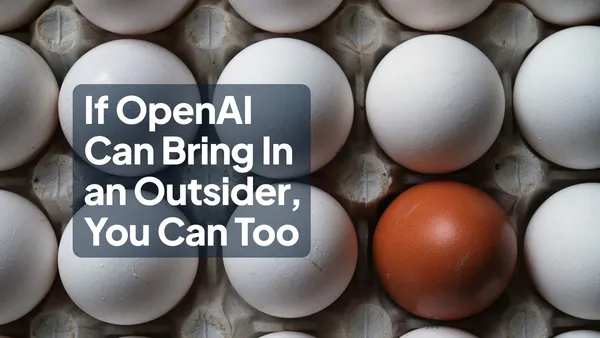
Almost anyone can believe in your mission for 45 minutes.
That’s the problem with asking about it in an interview. And it’s the problem OpenAI has just signed up for.
1. What’s happening
Fortune’s Emily Forlini reported on 5 October that OpenAI is piloting a “mission interview”, and OpenAI confirmed it to Fortune.
So yes, it’s true.
It’s a pilot, not a company-wide rule. It starts with the marketing and HR teams.
Candidates get a separate conversation about how they would add to OpenAI’s mission. The stated goal is to see how they think: their judgement, and how they weigh trade-offs. OpenAI says there is no “right” answer, and that scepticism and disagreement are welcome.
I’ve already written about two parts of this: the interviewer who comes from another team, and the training to certify them. This time I want to look at the question in the middle. Can an interview really tell you who means it?
Here’s what OpenAI is working with:
- About 8,000 employees worldwide, and 830 open roles, according to Fortune.
- About 4,500 employees back in March, according to the Financial Times, with a plan to reach 8,000 by the end of 2026. OpenAI didn’t comment at the time.
- $935,000 a year in total pay, in one offer to a software engineer with six years of experience. That one comes from an anonymous post on Blind, quoted by Fortune, so treat it as a story, not a fact.
Nearly doubling in a year, at this scale, makes it hard to keep one standard across teams. I understand why they want this.
2. Why it’s hard
OpenAI isn’t alone.
Fortune says Amazon and Meta have their own versions, and calls them “somewhat akin to a test of cultural fit”.
In August, Axios reported on Anthropic’s culture interview. Some candidates said they were asked how they’d feel if a safety decision sent the company’s stock to zero. Two former employees disputed that this question is used. A former employee also said the questions are suggested, not fully scripted, which may be why people remember different versions.
Mission or money. And for someone like me, who’s spent more than a decade of my professional life working on sustainability and impact, this hits too close to home.
It’s a fair thing to want to know.
I have experienced this first hand myself when growing my teams. But…
Most people say they want values. In a 2026 iHire survey of 933 US candidates, 81% said they’re more likely to apply if a job ad mentions the company’s core values. iHire sells recruitment services, so please read it with that in mind.
Far fewer feel it at work. Gallup and Stand Together surveyed 4,475 US workers in August 2025. 45% said they work mainly for the paycheck and benefits. Only 18% said their job has a purpose they personally believe in.
So 81% like the idea, and 18% say they have it. I find it funny how the digits are reversed in these stats. Still, the gap is hard to miss.
And candidates know what you want, I mean expect, to hear. In research by Julia Levashina and Michael Campion, more than nine in ten undergraduate job candidates reported some faking in interviews. That’s students, from 2007, and most of it was polishing, not lying. Still, “Why our mission?” is about the easiest question to polish. It’s also one AI can now help anyone rehearse to perfection.
For me, the honest answer, “I like the work and I need the pay”, is a perfectly good one. And from my experience, really motivated candidates are quick to lay down their drivers in front of the interviewer during the first 10 minutes of the interview. So sometimes, you don’t even have to ask…
A mission interview might punish it. You might end up hiring the best storyteller, not the person who cares most. So in mission interviews, like any other interview, we need to evaluate the candidates based on our predefined criteria. This is what helps us separate people good at interviewing from people who are just good at what they do.
There’s a risk for your company too. In the same iHire survey, 45% said they had worked for a company that didn’t live by its stated values. A candidate may be testing your mission as hard as you’re testing theirs.
But enough of that now.
➡️ Let me show you how I decided my mission-driven questions in my interviews. 👀
3. What I asked in 2019
I’ve designed my own version of this. I had to.
In 2019 I was hiring for my greenTech startup: a back-end engineer, a front-end engineer and a graphic designer. I asked all of them the same question:
“What do you do to care about the environment in your free time?”
One told me he is vegan, for climate reasons. Another told me she always brings a reusable tote bag to the supermarket, and prefers buying products that aren’t wrapped in plastic. The third collected trash in a bin bag every time he went for a hike in the hills and mountains around his home.
None of these habits told me anything about their actual technical knowledge. But they showed my team that these people lived our mission in real life, long before we even met them, and took care of the nature around them.
We all intrinsically agreed on the mission.
I invite you to check out what the question asks.
Not “Do you care about the environment?”, a yes-or-no type of question. Everyone would say ‘yes’ if we’d asked that.
It asks what you do when nobody is watching.
4. What OpenAI got right
One, it says it’s looking at reasoning and trade-offs, not at who loves the mission most.
Two, it says disagreement is fine.
And three, the interviewer doesn’t come from the hiring team.
That’s most of the way to a proper interview.
What we still don’t know is the part that matters most. Fortune’s piece doesn’t say how answers are scored, or how OpenAI will tell if it worked and how happy they end up being with these new hires.
Scoring, for me, is where this lives or dies.
In a large review of hiring research by Paul Sackett and colleagues (2022), structured interviews came out as the best predictor of job performance on average, at r = .42, though results varied a lot from study to study.
That’s about structured interviews in general, not mission interviews. Without the structure, a values chat is just a nice talk with a score that means nothing at the end.
In my own interviews, every candidate in a role gets the same questions and the same scoring guide.
A mission round deserves the same.
5. How to run a mission interview that works
If you want to add a round like this, or you already have one, here’s what I’d do.
1. Ask about a trade-off, not a belief. Don’t ask “Why does our mission matter to you?” Ask about a time they had to choose between two things they cared about, and what it cost them.
2. Ask what they did, not what they would do. Anyone can describe the right thing to do. Real examples have names, dates and awkward details.
3. Write down what a good answer looks like first. Do it before the first candidate. If two interviewers can’t agree on it, you’re measuring how much they liked the person.
4. Make “it’s also about the money” a safe answer. Say so out loud at the start. Then score the reasoning, not the enthusiasm.
5. Use someone who doesn’t need the seat filled. Someone from another team has less reason to hear what they want to hear.
6. Bring your own example. Tell the candidate about a time your company gave something up for its values. If you can’t think of one, that’s useful to know too.
6. Your checklist
- We can say what this round tests, in one sentence
- The questions are about real decisions and trade-offs
- Every candidate gets the same questions
- We wrote a scoring guide before the first interview
- Disagreeing with us can’t lose a candidate points
- The interviewer is trained, and from outside the hiring team
- We have a real example of living our values
TL;DR: OpenAI’s mission interview is real, but it’s a pilot. People will tell you they believe in your mission, so don’t ask them. Ask what they gave up, and score the answer.
What’s the most honest answer you’ve heard to “Why do you want to work here?”
Need Help Building a Round Like This?
If you’d like help building a round like this, our Tech Interviewer Training teaches your team structure, scoring and feedback. And if you’d rather have someone from outside in the room, that’s what our Tech Assessments are.
Tech Interviewer Training
Teach your team structure, scoring and feedback, so every round measures what it says it does.
Tech Assessments
Structured technical interviews run by a senior engineer or CTO from outside your team, with a report within 24 hours.
Sources
- Emily Forlini, OpenAI is piloting a ‘mission interview’ for candidates. Fortune, 5 October 2026.
- OpenAI plans to almost double its headcount this year, FT says. Fortune, 21 March 2026.
- Scoop: Anthropic candidates face blunt money question. Axios, 24 August 2026.
- iHire survey: 81% of candidates are more likely to apply if a job ad mentions the employer’s core values. 21 May 2026.
- Gallup and Stand Together, The Power of Purpose. Survey of 18 to 25 August 2025.
- Levashina, J. and Campion, M. A. (2007), Measuring faking in the employment interview. Journal of Applied Psychology 92(6), 1638–1656.
- Sackett, Zhang, Berry and Lievens (2022), “Revisiting meta-analytic estimates of validity in personnel selection”, Journal of Applied Psychology 107, 2040–2068. Summary: O’Shea and Fox Luscombe, Is cognitive ability the best predictor of job performance? SIOP.
This post first appeared in Shortlisted by Kat. Photo by Sasun Bughdaryan on Unsplash.