Startup Technical Due Diligence: Independently Verify a Startup's Technology
Want to know if a startup's technology is real, technically sound and capable of delivering what its founders promise?
We provide independent technical due diligence for startups and investors. Two current and former startup CTOs evaluate the startup's product, code, architecture, security, engineering team and technical claims to establish whether the technology actually works and whether the team can deliver its roadmap.
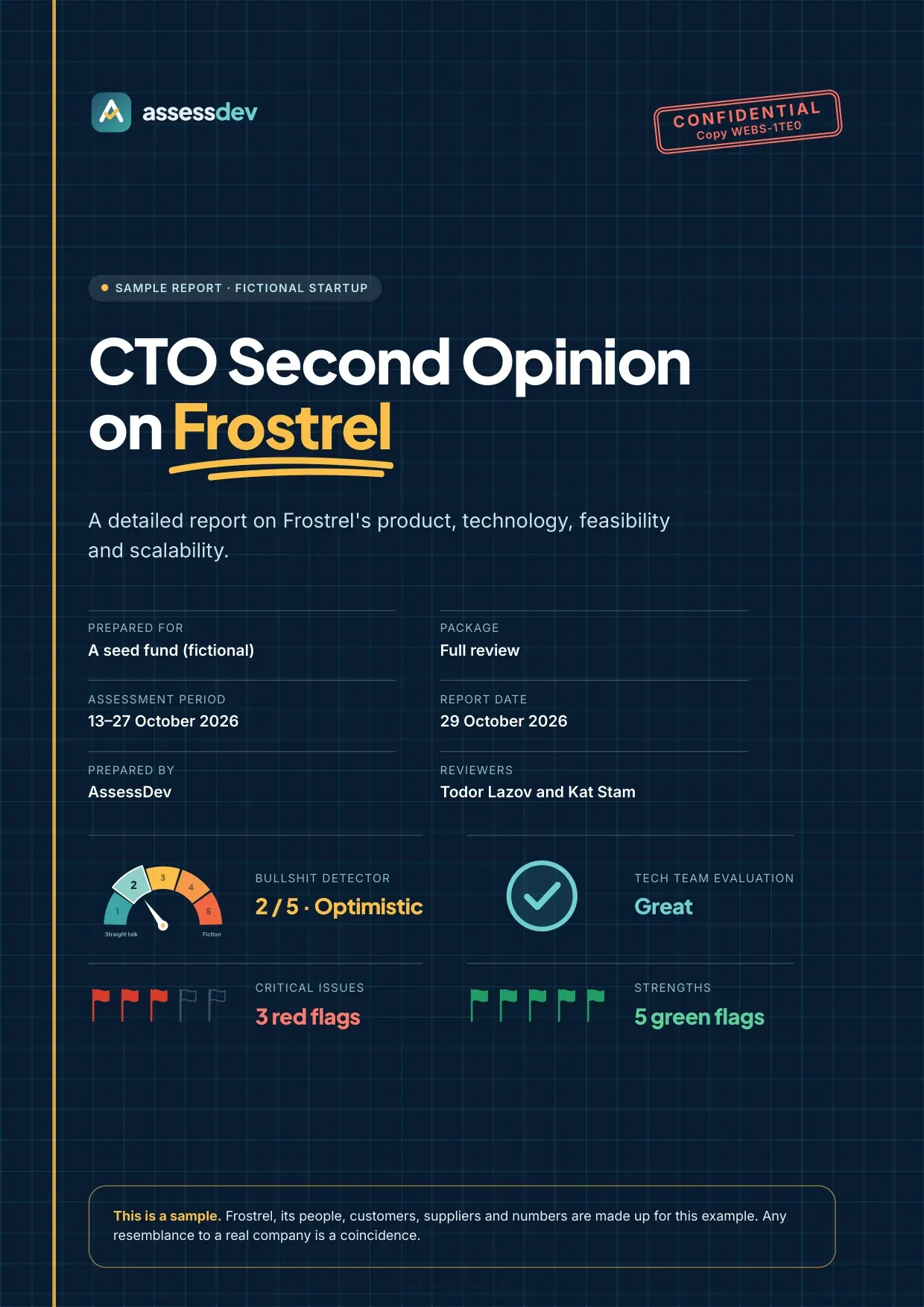
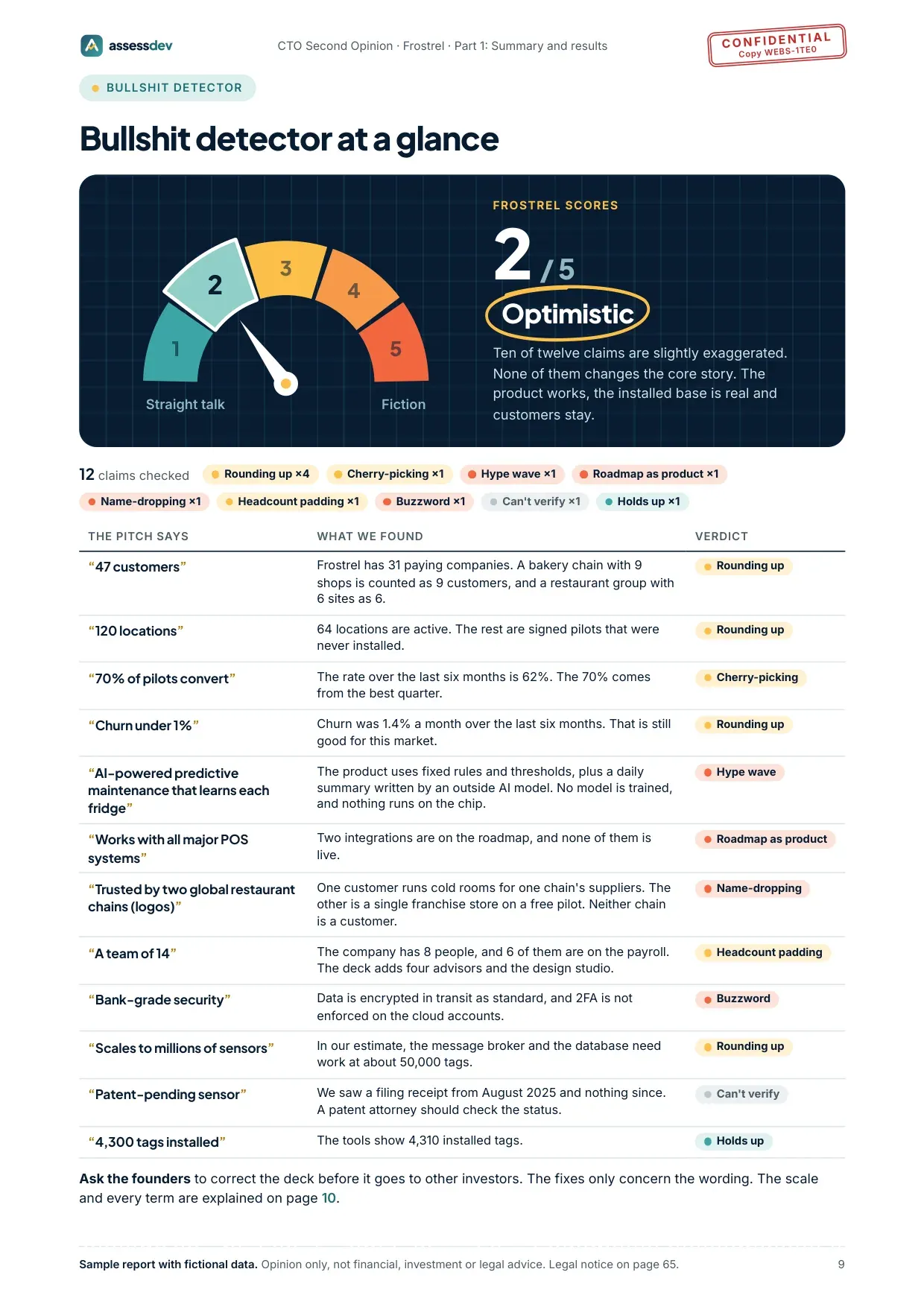
The scores from our sample report on a made-up startup
Startup technology assessment
Our startup technology assessment helps investors, venture capital funds, angel investors and founders identify technical risks before an investment or fundraising round.
Every assessment includes:
Independent evaluation of the startup's technology and product.
Code, architecture and security review.
Technical assessment of the CTO and engineering team.
Verification of claims made in the pitch deck and product demo.
Identification of technical red flags and opportunities.
A written technical due diligence report with actionable recommendations.
We use 243 assessment criteria across 14 areas, with the same evaluation framework for every startup.
The result: an evidence-based second opinion on whether a startup can actually build what it promises.
Sample report
Read the Sample Report
A full CTO Second Opinion on Frostrel, a made-up startup that makes fridge sensors. Read the executive summary below, then leave your details and we'll send you the whole report.
Read the full sample report
Leave your details and we'll send you the report.
Thank you. We'll send you the sample report by email.
What is in the report
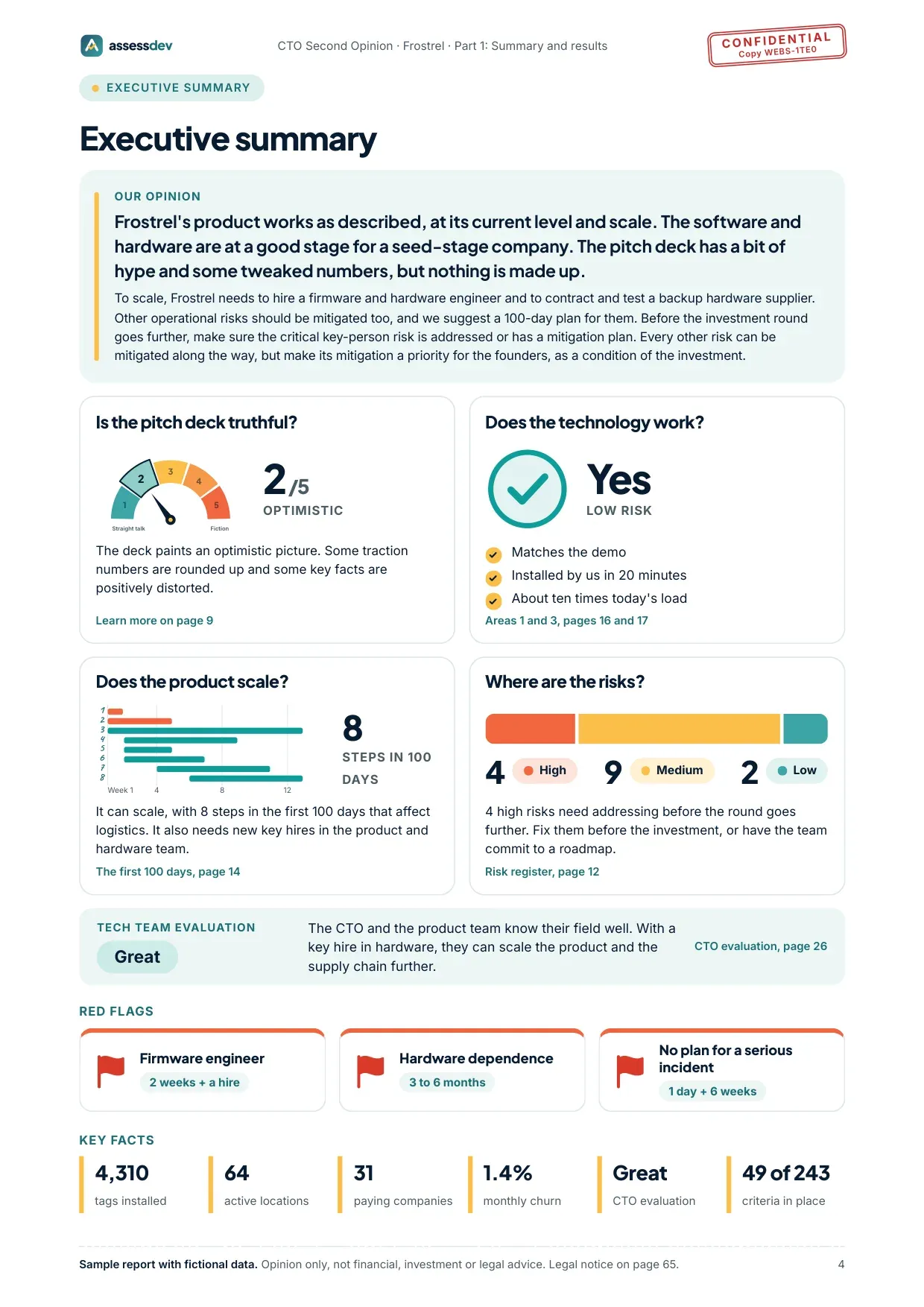
Executive summary that answers the four questions investors ask first
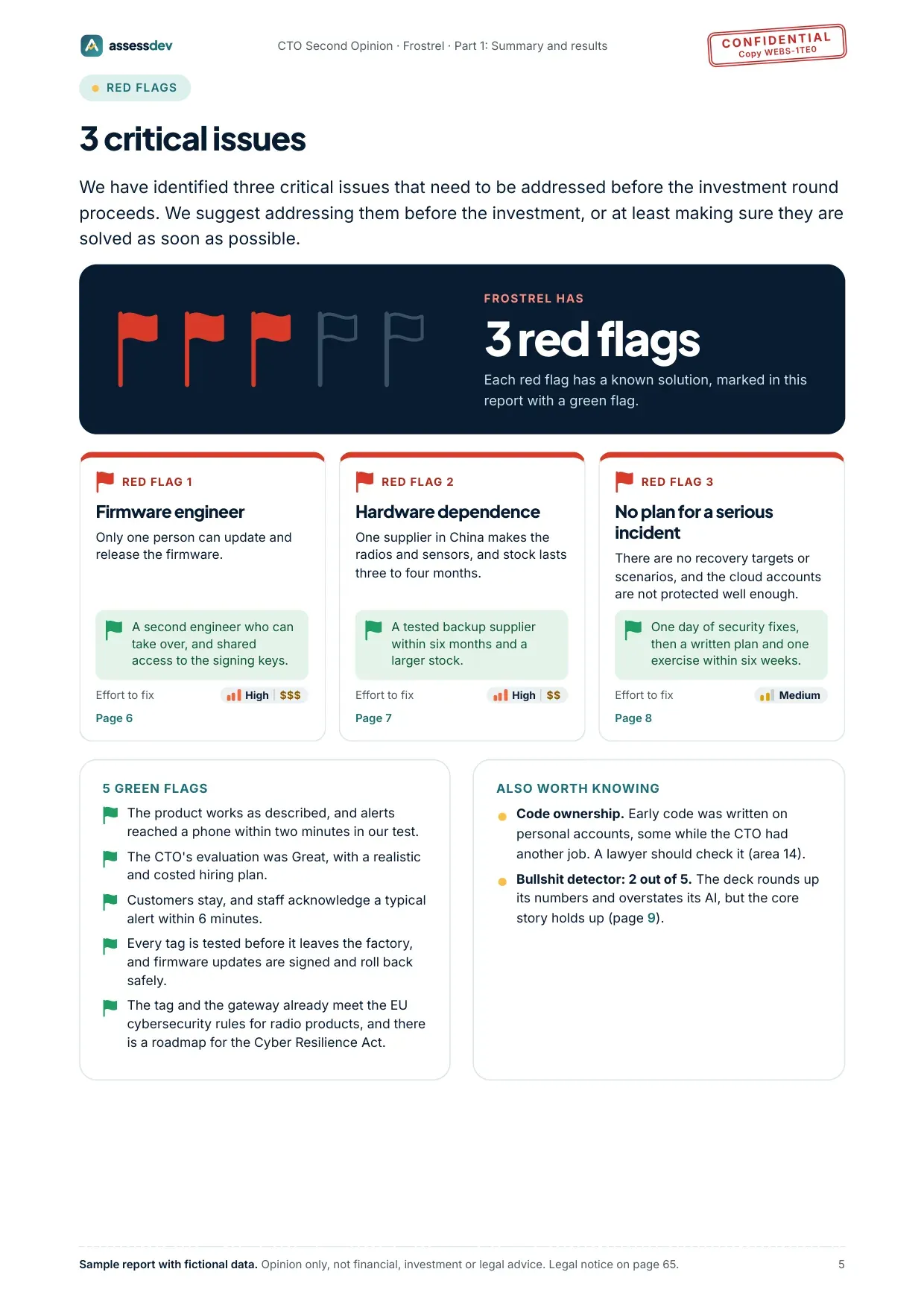
3 critical issues as red flags, each with its solution
Bullshit detector with every claim in the deck checked
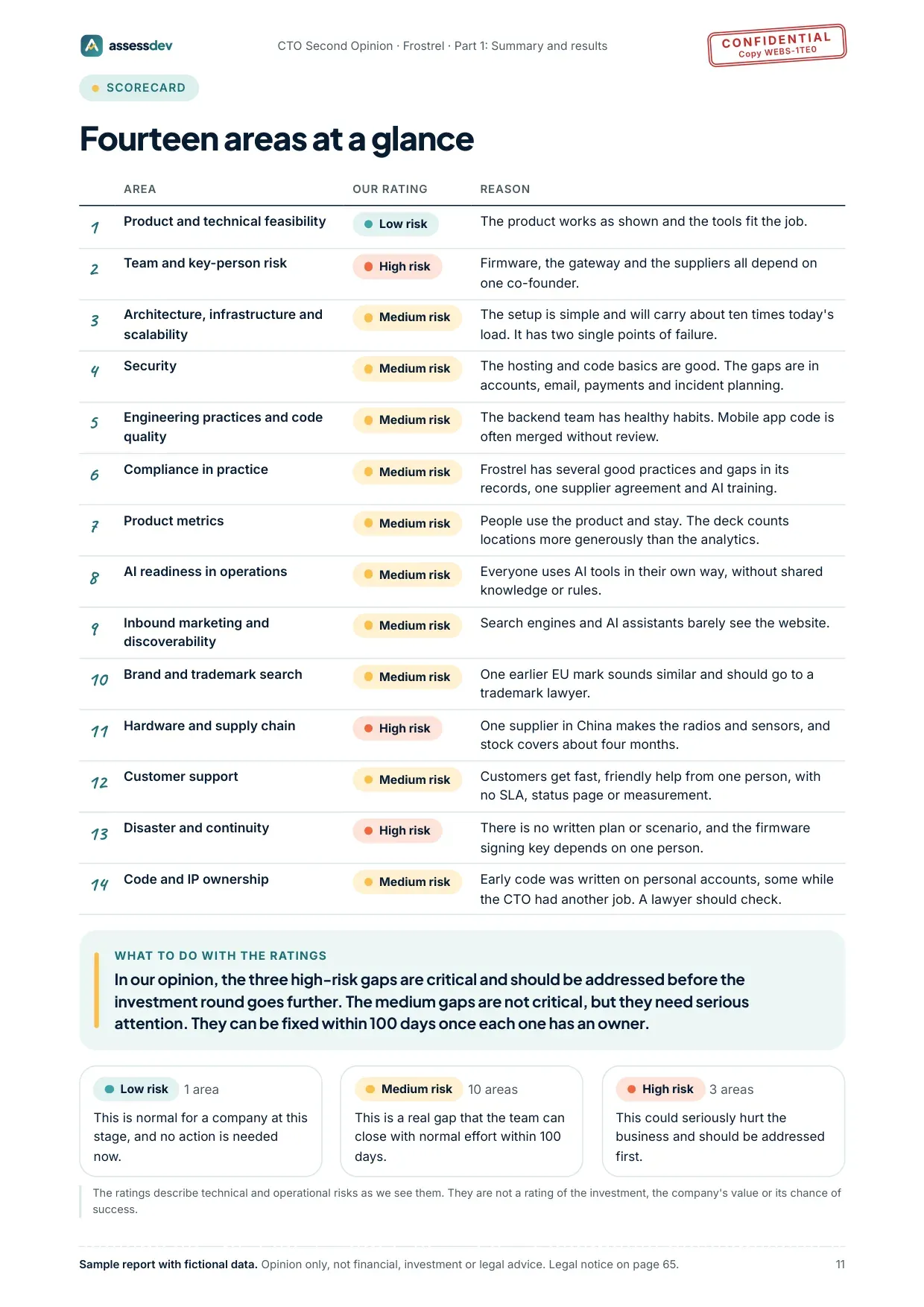
Scorecard with a risk rating for each area
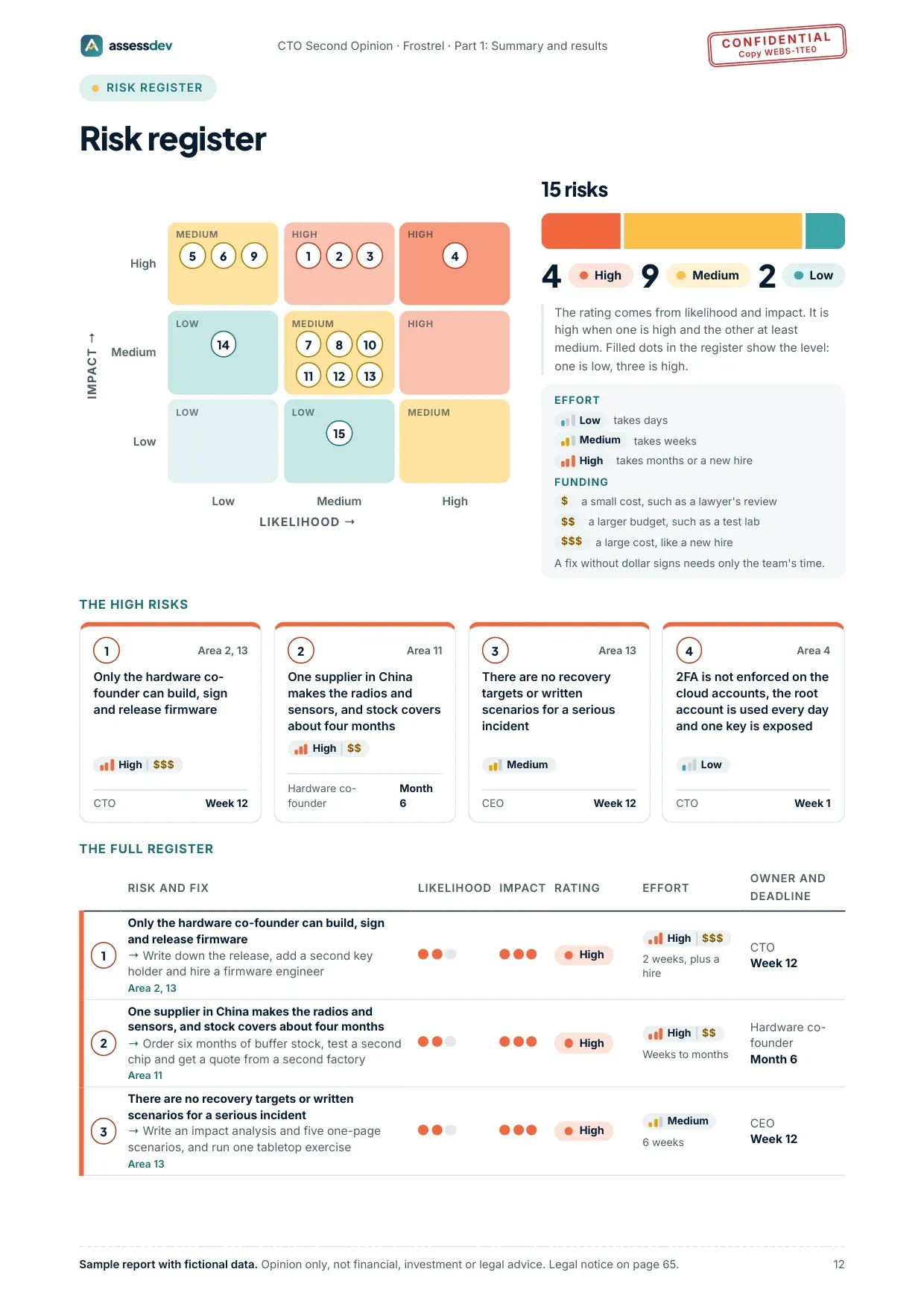
Risk register with likelihood, impact, effort and funding
The first 100 days after the investment
Findings for all 14 areas and 243 criteria
Code figures, the tech stack and a graded CTO evaluation
The founders’ response to our findings
Frostrel, its people, customers, suppliers and numbers are made up. Every copy of the PDF carries its own copy number.
Is this startup's technology legit?
How to Verify Whether a Startup's Technology Is Legit
Before investing in a startup, you need to know whether its technology actually works, whether the product matches the founders' claims and whether the engineering team can deliver what is promised.
The most reliable way to do this is through an independent startup technical due diligence assessment.
A proper assessment should:
Test the actual product instead of relying only on a pitch deck or demo.
Review the source code, software architecture and technical infrastructure.
Evaluate the CTO and engineering team's capabilities.
Verify technical claims against real evidence.
Identify technical debt, security weaknesses and operational risks.
Assess whether the product and team can scale.
A proper technical evaluation should answer six fundamental questions:
1
1. Does the startup's product actually work?
Test the real product rather than relying exclusively on presentations, screenshots or demonstrations.
2
2. Is the technology technically sound?
Review the source code, software architecture, infrastructure and engineering practices.
3
3. Can the technology scale?
Determine whether the architecture and engineering team can support the startup's projected growth.
4
4. Is the CTO and engineering team capable?
Evaluate technical leadership, engineering competence, team structure and key-person dependencies.
5
5. Are the founders' technical claims accurate?
Compare statements in the pitch deck, website and product demonstrations against technical evidence.
6
6. What are the technical risks?
Identify security weaknesses, technical debt, IP ownership concerns, operational dependencies and other issues that could affect the investment.
AssessDev provides independent startup technical due diligence through its CTO Second Opinion service. Two current and former startup CTOs evaluate the technology, product and engineering team using 243 criteria across 14 areas.
The result is a detailed technical due diligence report that helps investors understand what works, what doesn't and what needs fixing before they invest.
Who writes the report
Reviewed by Current and Former Startup CTOs
Our reviewers are current and former startup CTOs. We have no financial interest in the startups we review.
Todor Lazov
Principal Interviewer, AssessDev · Co-founder and CTO, goodbag
Lead reviewer
Todor is a serial tech founder and has been co-founder and CTO of goodbag, an NFC hardware and app startup, since 2015. Todor built its first prototype, set up the quality control of more than a million NFC chips and hired the product and engineering team. With 15 years of coding experience, Todor has run more than 500 technical interviews for AssessDev and teaches teams to work with AI agents.
Co-founder, AssessDev · LinkedIn Top Interviewing Voice
Team and CTO evaluation
Kat was CTO of two startups for eight years combined and has hired engineers from front-end developers to CTOs since 2018. Kat holds a dual master’s degree in Artificial Intelligence and has run more than 2,000 technical interviews. Kat took part in startup programmes with the European Space Agency, Google for Startups and Startup Lisboa.
Todor and Kat lead every review. For specialist areas such as security, hardware and firmware, AI and data, mobile and cloud, they bring in current and former CTOs and senior engineers from the AssessDev network.
Our experience
We have been on both sides, as founders and as evaluators.
We have raised money from grants, angels and VCs, in rounds of different sizes and stages.
As founders of different ventures, we went through due diligence ourselves when we raised.
We evaluate tech teams every day and support startups as embedded interviewers and fractional CTOs.
One score from 1 to 5 for how far the pitch deck matches the evidence.
Red flags
Critical issues that could stop the deal, each with a fix.
Green flags
The solutions and what the team already does well.
Team grade
A graded three-part evaluation of the CTO and a review of the team.
Product test
We install and use the product ourselves and compare it with the demo.
Feasibility
Whether the team can build what the deck promises.
Scalability
Whether the product and the team can handle growth.
243 criteria
The same fixed criteria in 14 areas for every startup.
The questions investors ask
The executive summary answers the questions investors ask first, on one page. The rest of the report shows the evidence behind each answer.
Is the pitch deck truthful?
Our bullshit detector checks every claim in the deck against the code, the tools and the contracts. One score from 1 to 5 tells you how far the pitch matches the evidence.
Does the technology work?
We install and use the product ourselves and compare it with the demo. We read the code and the architecture to see whether the product does what the deck says.
Does the product scale?
We check whether the architecture, the team and the operations can handle growth. You get the steps the product needs in the first 100 days after the investment.
Where are the risks?
Every risk goes into a register with its likelihood, impact, fix and effort. The critical issues are shown as red flags, and each one has a green flag with the solution.
Great
Can this team build it?
We run a graded three-part evaluation of the CTO and interview the engineers. We look for key-person risk, gaps in the team and a realistic hiring plan.
See every answer in our sample report
Our sample report answers each question for Frostrel, a made-up startup that makes fridge sensors.
Investors asked us for it. We check every claim in the pitch deck, on the website and in the data room against the code, the tools and the contracts. One score from 1 to 5 tells you how far the pitch matches the evidence.
We name every rounding up, cherry-pick, hype wave and name-drop, and we show you what we found instead.
Rounding up
Cherry-picking
Hype wave
Buzzword
Roadmap as product
Name-dropping
Headcount padding
Vanity metric
1Straight talk
2OptimisticThe sample startup
3Stretched
4Spin
5Fiction
Red flags and green flags
Critical Issues With Their Solutions
A red flag is a critical issue that could stop the deal. Every red flag comes with green flags that show the solution, the effort it takes and whether it needs funding.
Red flag 1
Only one person can update and release the firmware.
A second engineer who can take over, and shared access to the signing keys.
Effort to fixHigh$$$
Red flag 2
One supplier in China makes the radios and sensors, and stock lasts three to four months.
A tested backup supplier within six months and a larger stock.
Effort to fixHigh$$
Red flag 3
There is no plan for a serious incident, and the cloud accounts are not protected well enough.
One day of security fixes, then a written plan and one exercise within six weeks.
Effort to fixMedium
Green flags for what already works
The product works as described, and alerts reached a phone within two minutes in our test.
The CTO’s evaluation was Great, with a realistic and costed hiring plan.
The tag and the gateway already meet the EU cybersecurity rules for radio products.
Examples from our sample report on Frostrel, a made-up startup. One dollar sign is a small cost and three are a large cost, like a new hire.
Who it is for
For Investors and for Startups
For investors
Know whether the team can build it before you fund it
For VCs, angel investors, accelerators and grant givers who need a technical opinion on a startup before a term sheet, an investment committee or a cohort decision. Your CTO Second Opinion answers these questions.
Does the product and tech work as described, or is it just an AI prototype with buzzword hype?
How truthful is the traction in the pitch deck?
Can the tech and product team scale, and are they the right engineers for the job?
Which red flags need fixing, and what are the risks?
How much technical debt and vibe-coded code does the startup have?
Is the product out there, or is it just a roadmap?
Do the tech and code belong to the company?
What should the tech team focus on before and after an investment?
For startups
Fix your weak spots before investors find them
For founders who want to go into a fundraise with fewer open questions. You get the same checks we run for investors and the report stays with you.
Increase your valuation when you fundraise by going in prepared.
Speed up the tech due diligence in your investment round by making sure every document and issue is already addressed.
Get a second opinion and a clear 100-day action plan for fixing any red flags that might become a dealbreaker when you fundraise.
A positive second opinion gives you more leverage when you fundraise. A neutral or negative one helps you prioritise your tech and product and make a stronger offer to investors.
Fixed criteria
243 Criteria in 14 Areas
Every startup is checked against the same 243 criteria. Each one has a result and a note on what we saw, so you can compare startups with each other.
1
Feasibility8
Whether the product works as described and the team can build what the deck promises.
2
Team8
The CTO, the engineers, key-person risk and the hiring plan.
3
Architecture and scalability8
Whether the architecture, the infrastructure and the costs can handle growth.
4
Security74
Accounts and access, infrastructure, devices, payments and how the team handles incidents.
5
Engineering practices9
Code review, tests, releases, technical debt and how the team uses AI to write code.
6
Compliance in practice11
How GDPR, the EU AI Act, licences and product rules are put into practice.
7
Product metrics8
Whether the numbers in the pitch deck match what the tools show.
8
AI readiness in operations7
How the company itself works with AI.
9
Inbound marketing and discoverability8
How customers and AI assistants find the company online.
10
Brand and trademark6
Database searches for names and trademarks that could conflict.
11
Hardware and manufacturing6
Suppliers, production, testing and certification for startups with their own hardware.
12
Support43
Support roles, response times, the help centre and service levels.
13
Disaster and continuity40
Recovery plans, backups and what happens when a key person or supplier is gone.
14
Code and IP ownership7
Who wrote the code, on which accounts, and whether it belongs to the company.
Packages
Three Ways to Work With Us
Quick Check
For investors before a term sheet
About 5 working days
Interviews with the CTO and the team
A walkthrough of the product and the architecture
The bullshit detector, red flags and green flags
Feasibility, team, architecture, security and engineering at summary depth
Each package has a fixed fee, quoted once we know the size of the startup. The Quick Check fee is credited against a Full Review of the same startup.
How it works
From Kick-off to Debrief
1
Kick-off
We agree the scope with you. The startup gives us read access to the code, the cloud console and the task board.
2
Inspection
We interview the CTO and the engineers, test the product and check every criterion against the evidence.
3
Report and debrief
You get the CTO Second Opinion as a PDF with a one-page summary first. Then we walk you through it on a call.
Questions
Questions Investors and Founders Ask
How do I check if a startup's technology is legitimate?
The most reliable way is to commission an independent technical due diligence assessment. An experienced technology reviewer should test the actual product, inspect the source code and architecture, interview the CTO and engineering team, and compare the technical evidence against the startup's claims. This helps identify whether the product works, whether the team can deliver its roadmap and whether there are technical risks that could affect an investment.
Our CTO Second Opinion provides this assessment through two current and former startup CTOs, using 243 criteria across 14 areas.
How do I evaluate a startup's technology?
Look at the product, the code and the team together. Test the product yourself, review the code, the architecture and the infrastructure, and interview the CTO and the engineers. Then check whether the product and the team can scale and which risks need fixing first. Our CTO Second Opinion covers all of this with 243 criteria in 14 areas.
Who can independently evaluate a startup's technology before an investment?
An independent reviewer who has built and run the technology of a startup. Our CTO Second Opinion is carried out by Todor Lazov and Kat Stam, two current and former startup CTOs with no financial interest in the startups they review. They test the product, read the code, interview the team and check 243 criteria in 14 areas.
What is an independent startup technology assessment?
It is a review of a startup's product, code, architecture, security and team by someone outside the company and its investors. It shows what has actually been built, how well it works and which technical risks need fixing. Our CTO Second Opinion is this kind of assessment.
How can I verify whether a startup's product and technical claims are real?
Test the product yourself and compare every claim in the pitch deck, on the website and in the demo with the evidence. That means the code, the tools, the analytics and the contracts. Our bullshit detector does this for every claim and scores the whole pitch from 1 (straight talk) to 5 (fiction).
How do I evaluate a startup's CTO and engineering team?
Interview the CTO and the engineers about real decisions they made, and check the code they wrote. Look for key-person risk, gaps in the team and a realistic hiring plan. We run a graded three-part evaluation of the CTO and interview two or three engineers.
What should a startup technical due diligence report include?
A one-page summary, the critical issues with their solutions, a check of the pitch deck's claims, a risk register, a plan for the first 100 days and the findings for every area checked. Our sample report shows all of these for Frostrel, a made-up startup.
Can someone review a startup's code before I invest?
Yes. In a Full Review we read the code and run automated scans for code quality, dependencies, licences and exposed secrets. The startup gives us read access to its code repositories for the assessment.
How much does startup technical due diligence cost?
Each package has a fixed fee, paid in advance and quoted once we know the size of the startup. The Quick Check fee is credited against a Full Review of the same startup. Write to us for a quote.
How long does a technical due diligence assessment take?
A Quick Check takes about 5 working days. A Full Review takes 2–3 weeks, and a Fundraising Readiness Check takes 1–2 weeks.
What is a CTO Second Opinion?
It is our tech due diligence for investors. Two current and former startup CTOs interview the team, test the product, read the code and check 243 fixed criteria in 14 areas. You get a written opinion on whether the team can build what it promises and which risks to fix first.
Is a CTO Second Opinion investment advice?
No. We give an opinion on the technology, the tech team and the technical and operational risks. We never say whether to invest, and we don’t rate the deal, the valuation or the terms. The decision to invest is always yours.
What does a CTO Second Opinion not cover?
We are not a financial consulting company. We don’t review financial models, forecasts, valuation, tax or the cap table.
We are not trademark or patent lawyers. Our trademark scan looks for potential conflicts, and a qualified lawyer should confirm any finding.
Our GDPR and EU AI Act checks look at how the rules are put into practice. They are not legal advice.
The report reflects what we saw on the dates of the assessment, based on the information and access the startup gave us.
What do you need from the startup?
Read access to the code repositories, the cloud console and the task board.
Interviews with the CTO, two or three engineers and the product lead.
The architecture overview, the pitch deck and the product analytics.
Can a startup order a CTO Second Opinion?
Yes. Founders book the Fundraising Readiness Check before they raise. They get a prioritised list of fixes, so they can solve their weak spots before investors ask about them. If an investor later asks us to review the same startup, we tell them about the earlier check and they decide whether we go ahead.
What is the bullshit detector?
We check every claim in the pitch deck, on the website and in the data room against the evidence. Each claim gets a verdict, such as rounding up, hype wave or holds up. Then the whole pitch gets one score from 1 (straight talk) to 5 (fiction).
What are red flags and green flags?
A red flag is a critical issue that could stop the deal, such as a single person who holds the firmware keys. Every red flag comes with green flags that show the solution, its effort and whether it needs funding. Green flags also mark what the team already does well.
Which startups do you review?
Seed and Series A startups with software, hardware or both. A startup with more than one product, more than 20 engineers or a Series B round gets its own quote.
Who can read the report?
The report is for the client who ordered it, and every copy carries its own copy number. Anyone else can read it only with our consent.
Who writes the report?
Todor Lazov and Kat Stam, current and former startup CTOs. Between us we’ve raised several rounds from grants, angels, funds and VCs, and we have run thousands of technical interviews. Meet the team.
Before you invest in a startup, find out whether its technology is real.
Two current and former startup CTOs independently examine the product, code, team and technical claims. Get the evidence, discover the red flags and understand whether the startup can deliver what it promises.