Most candidates aren't breaking your AI rules. They just can't find them.
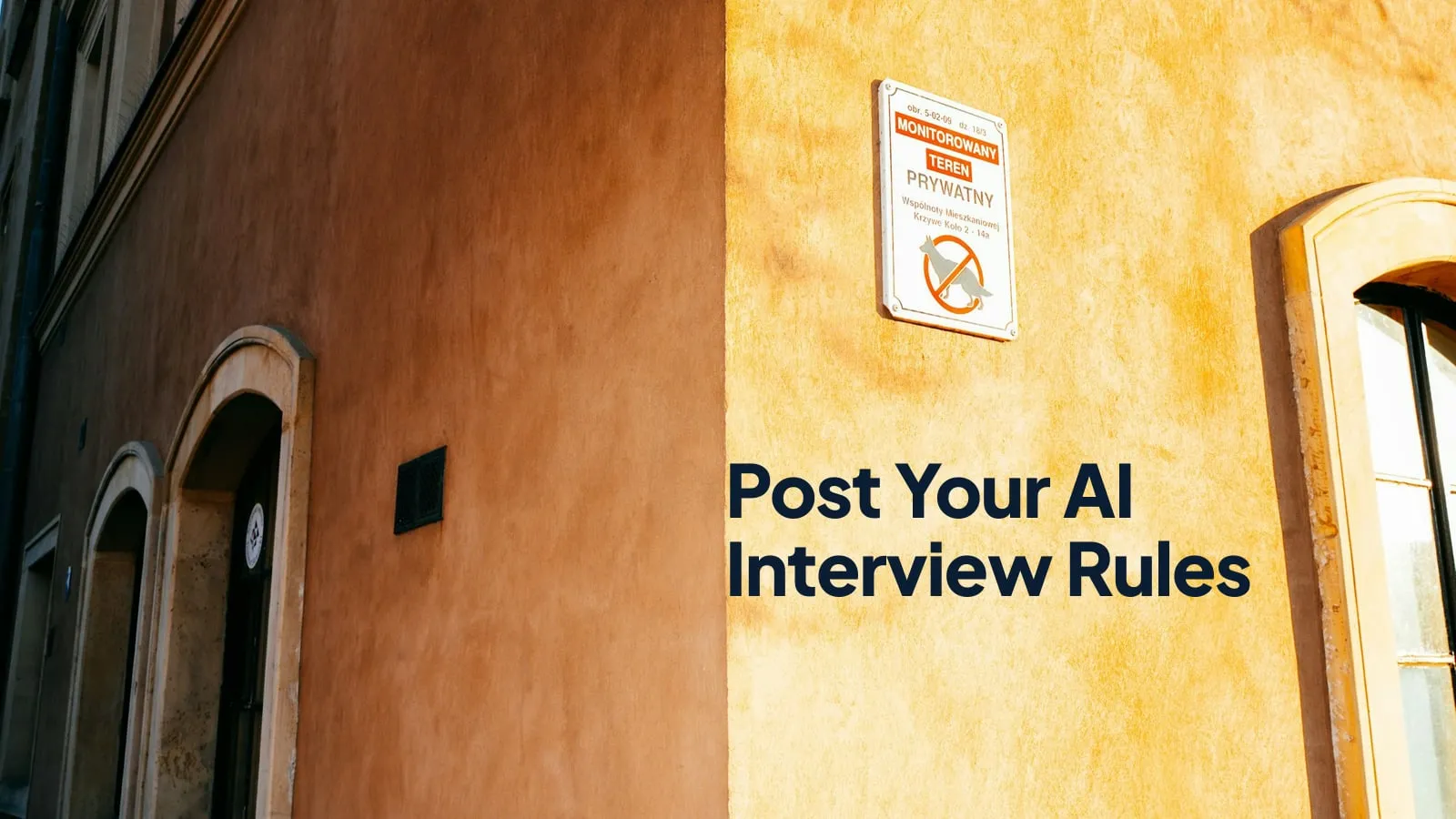
A park can fit its rules on one sign. Most hiring teams can't fit theirs in one email.
Candidates Are Now Told to Ask
On 13 October, CNBC Make It published an interview with Daniel Chait, the CEO of Greenhouse. He gave it at Forbes' Future of Work Summit in New York. His advice to job seekers was to ask the company about its AI rules, both for the interview and for the job.
That's worth sitting with. Candidates now have to ask because we don't tell them.
The rules also change from step to step. The article gives a simple example. Many recruiters frown on a candidate who uses AI live in a screening call. The same company may want them to use AI on the take-home task, because that's how the team works now.
In Chait's words, "The rules are often not published, not known and changing very quickly."
So the candidate guesses. If they guess "no AI" and the team expected AI, they look slow. If they guess "yes" and the team didn't expect it, they look like a cheater. It's the same person with the same skills and a different guess.
What Candidates Say
Greenhouse surveyed job seekers for its 2026 Candidate AI Interview Report, published in May. The US findings come from 1,200 job seekers.
- Only 18% say employers have clear AI policies.
- 70% were never clearly told upfront that AI would be evaluating them. One in five (21%) found out only once the interview started.
- 38% have walked away from a hiring process because it included an AI interview.
- 27% named a company not disclosing how it used AI as a reason to walk away.
Here's the part I find most interesting. Only 19% want less AI in hiring, and 44% want upfront disclosure.
So candidates can live with AI in your process. What they want is to know the deal clearly, before the interview starts.
Why Nobody Wrote the Rule Down
Most teams never sat down and wrote the rule. The hiring manager has one in their head. The recruiter has another. The person who wrote the live challenge a year ago had a third.
Each interviewer then applies their own version. Two candidates for the same role can get two different rules, and two different scores for the same behaviour. That undoes the point of a structured interview, where every candidate gets the same questions and the same rubric.
The Honest Trade-Off
AI tools change every few months, and a written rule can feel out of date the week you publish it. That's a fair point. A rule you update every quarter is still better than a rule nobody wrote down.
You also don't have to pick a side. Banning AI in an interview is defensible. So is allowing it on a take-home when your team uses AI every day. What matters is that the candidate knows which rule applies to which step.
What I Do in My Own Interviews
I ask candidates not to use AI during my technical interviews, and I tell them why.
I want to hear how they think. Once an AI answer is on the screen, it's very hard to think past it. It pulls your answer in its direction, even when you know better. At that point I'm interviewing the tool, with a person reading it out loud.
The rule is the easy part. What makes it fair is saying it out loud, early and with the reason. When people know the rule, they relax. A relaxed candidate is the one who shows you what they can really do.
Three Things to Do This Week
- Write one rule per step. Write a separate rule for the screening call, the take-home and the live interview. Each can say "allowed", "not allowed" or "allowed for X but not for Y". Keep each to one or two sentences. Make sure every interviewer knows the rule and agrees with it.
- Share it twice. Put the rule in the interview invite or your prep guide, so the candidate knows it before they start preparing. Then repeat it in the first two minutes of the interview and ask "Any questions about that?" People forget emails, and nerves don't help. It takes 20 seconds.
- Be open about AI scoring, and score by the rule. If an AI tool screens, records or scores any part of the process, tell the candidate before it happens. Say what it looks at and that a person makes the final call, and make sure that's true. If AI was allowed on the take-home, don't mark anyone down for using it. Score how they used it. Did they check the output? Can they explain the code? Can they say why they kept one suggestion and dropped another?
For hiring teams in the EU, telling candidates about AI is also a legal duty. I wrote about that in Your AI Hiring Deadline Moved. Your Disclosure Duty Did Not.
This is an afternoon of work. Possibly less.
A Quick Checklist
- We have a written AI rule for every interview step.
- All interviewers know the rule and agree with it.
- The rule is in the invite or prep guide.
- We repeat it at the start of each interview.
- We tell candidates when AI screens or scores them.
- A person reviews every AI score before a decision.
- Our scorecard matches the rule we gave.
So, honestly, do your candidates know your AI rules before the interview, or do they find out on the call?
Sources
- CNBC Make It, Sarah Jackson. Most job seekers aren't asking this important question in their interviews, but they should, says CEO of hiring platform. 13 October 2026.
- Greenhouse. 2026 Candidate AI Interview Report. 1 May 2026. 2,950 job seekers in five markets, with US findings from 1,200 US job seekers.
This post first appeared in Shortlisted by Kat. Photo by Tom Caillarec on Unsplash.
Interviews With Clear Rules
Every AssessDev tech assessment ends with a live challenge of about 30 minutes without AI tools. We tell candidates that rule before the interview and again at the start.