Nobody puts a shoe on their head to meet a person.
This month, the funniest job interviews on the internet all had one thing missing. A human on the other side.
1. What's Happening
On 11 November 2026, Sarah Bregel wrote in Fast Company that people can't stop trolling AI job interviewers. In one video, content creator Nick Reid meets an AI interviewer called "Karen" shirtless, with a shoe on his head. When Karen asks if he can get to his shifts reliably, he says: "Yeah. I have feet." The clip has nearly 8 million views.
In another video, a man speaks gibberish to his AI interviewer until it tells him: "This is an absolute waste of my time." YouTuber Graham Raabe sends his own AI "representative" to meet an AI interviewer, then leaves the room. The two bots are left talking in circles, with no human in sight.
To be fair, these are skits.
Burger King told Fast Company it doesn't use a tool like "Karen", and nobody's real job was on the line.
Yet millions of people watched and laughed (I was one of them too 😉). That tells you something about how it feels to sit alone in front of a bot.
2. Why It Happens
Automated interviews feel like nobody is there. In a 2020 study in the Journal of Managerial Psychology, Markus Langer and colleagues showed 148 people either a highly automated interview or a video call with a human interviewer. People saw the automated one as more consistent.
But it felt like no one was there (the researchers call it social presence), and that made the company itself look less attractive. Important: it is a small study with videos, not real interviews.
Here's what I think is going on. And by now, you should already know my point of view.
An interview is a two-way thing. The candidate puts in effort because someone gives effort back: listening, reacting, asking a better follow-up. Take the person away and you've told the candidate how much this step matters to you. And I have been working with hiring companies for the last four years. I know it matters to you a lot!
Most candidates will still try their best. Some, however, will give you the same effort you gave them. A few will try to be funny and give you a boot.
But the AI isn't useless. The biggest field study I know says the opposite. Brian Jabarian and Luca Henkel ran an experiment with about 70,000 applicants in the Philippines for entry-level customer support roles. Those interviewed by an AI voice agent got 12% more job offers, and they were 18% more likely to still be in the job after a month. Given the choice, 78% picked the AI. It's a working paper for a specific job role, from one country, but still. It is valid data.
Now the part that I think matters most.
In every group, human recruiters reviewed the interviews and made the hiring decisions. The AI step worked because people stood behind it. Real hoomans.
So the problem isn't the bot.
It's leaving the candidate alone with it.
3. What I Do in My Own Interviews
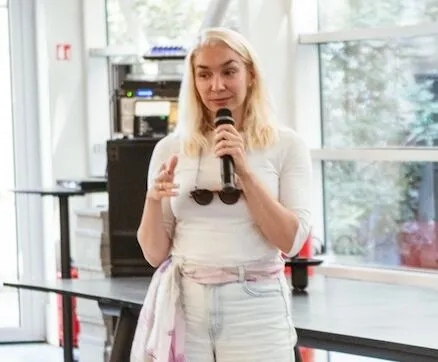
I interview like a colleague, not someone who got called in to destroy you. Human to human, with the same questions and a scoring guide for every candidate who interviews for a given position.
The structure, as we all know, keeps it fair.
The person, your dear Kat in this case, keeps it a conversation.
In my experience, really motivated candidates tell you what drives them in the first 10 minutes. Sometimes you don't even have to ask. But that only happens when someone is there to hear it.
I also note what kind of help a candidate needed in the live challenge (usually a coding task), and every candidate gets their feedback.
Every single one, Kat?
Yes, every single one. They deserve it. You know they deserve it. And I know you know they deserve it.
4. How to Fix Your Interviews
1. Keep the AI for the admin. Scheduling, reminders and basic checks like notice period or work permit. Candidates don't mind a bot for that. It saves everyone time.
2. Inform candidates about your AI use before, not during the interview. In a Greenhouse study of UK job seekers, reported by TechRadar, 82% weren't told beforehand that they'd be answering an AI avatar. Put it in the invite: what the AI does, what it doesn't, and why you use it.
3. Put a human name on every AI step. Say who reads the answers and when. "Someone from our team reviews every interview within two days" changes how the whole step feels. And if that someone had a name, aaah, we've hit the right spot.
4. Offer a human route. If a candidate asks for a person, give them one. It costs you one call and keeps people who would otherwise walk away quietly.
5. Keep the technical conversation human. That's where follow-up questions matter and where a nervous candidate needs someone to slow down. It's also where your future colleague first meets your team.
6. Close the loop with every candidate. Whoever reached the interview gets an answer and a reason. If the AI asked the questions, a human should still sign the feedback.
5. Your Checklist
- Our AI only handles admin and early basics, not the technical conversation.
- Every candidate knows about the AI step before it starts.
- Every AI step has a named human who reads the answers.
- Candidates can ask for a person, and we say yes.
- A human makes every hiring decision.
- Every candidate who interviewed gets written feedback.
TL;DR: The trolls aren't the problem. They're showing you how it feels when nobody is on the other side.
If your first interview round is with a bot, who is the first real person your candidate meets, and when?
Want a Senior Person in the Room?
If you'd like your senior candidates to meet a senior person, our CTO Tech Interviews put an experienced CTO in the room. And if you're about to invest in a company and want to know what its tech team can really do, there's Tech Due Diligence.
CTO Tech Interviews
Former and acting CTOs evaluate your tech leadership candidates, with a written report and recommendation for each.
Tech Due Diligence
Before you invest, find out what the company's tech team can really do.
Sources
- Sarah Bregel, People can't stop trolling AI job 'interviewers'. Fast Company, 11 November 2026.
- Langer, M., König, C. J., Sanchez, D. R.-P. & Samadi, S. (2020). Highly automated interviews: applicant reactions and the organizational context. Journal of Managerial Psychology, 35(4), 301-314.
- Brian Jabarian and Luca Henkel, Voice AI in Firms: A Natural Field Experiment on Automated Job Interviews. arXiv working paper, July 2026 (revised September 2026).
- Craig Hale, 'It would make me think twice about applying': Workers are pushing back at companies who insist on AI interviews. TechRadar, 15 November 2026.
This post first appeared in Shortlisted by Kat. Photo by Florian Schmetz on Unsplash.